 800-503-2102
 Chat with ZAF
Who Is at Fault When a Car Turns Left in Front of a Motorcycle? Your Rights Explained

Key Takeaways:
- Fault in left-turn motorcycle accidents usually falls on the turning driver, but insurance companies often seek to reduce payouts by assigning partial blame to the motorcyclist based on speed, visibility, and other factors.
- Collecting and preserving strong evidence—such as police reports, photos, witness statements, and surveillance footage—immediately after the crash is crucial to protect your claim value and ensure timely compensation.
- Accident victims have flexible options: handle claims independently with ZAF Legal’s AI assistant, access free consultations with attorneys, or choose full-service legal representation—all with Zero Attorney Fees (ZAF) paid upfront.
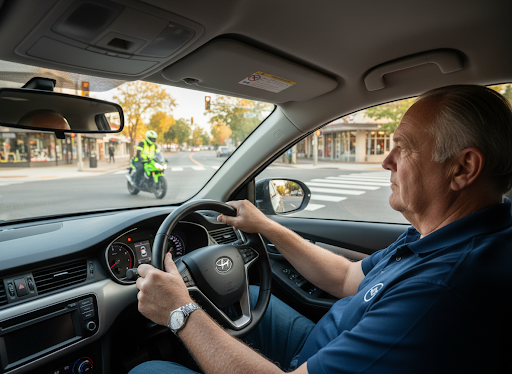
When a car turns left in front of a motorcycle, 44% of fatal two-vehicle motorcycle crashes involve exactly this scenario. Most left-turn crashes put the turning driver at fault for failing to yield right-of-way. However, insurance companies look for factors that might reduce your payout.
The legal reality is more complex. Understanding who is at fault when a car turns left in front of a motorcycle starts with right-of-way rules, then depends on evidence like your speed, road visibility, and whether traffic signals were working properly. You’ll learn how insurance companies decide liability, what evidence proves fault, and exactly what to do next without creating surprise medical bills. ZAF Legal’s free AI assistant can guide you through building your claim step by step, helping you understand your rights and determine if you need attorney support. With ZAF, you can build and manage your entire claim at zero cost using our AI-powered platform—or get a free consultation with an experienced attorney if you want a second opinion.
If you’re wondering whether it’s “worth it” to pursue a claim, or if you feel uneasy about the process, know that you were hurt through no fault of your own. Seeking fair compensation is your right, not something to feel guilty about. Riders are often unfairly stigmatized after collisions, but the facts and the law are what matter, and ZAF is here to help you stand on solid ground.
Start your free claim assessment with ZAF Legal and get answers in minutes.
How Fault Is Determined in Left-Turn Motorcycle Crashes
When you’re wondering how insurance companies decide liability when a car turns left in front of a motorcycle, the answer starts with traffic law but gets complicated fast. Insurers don’t just look at who had the right-of-way. They examine every detail that might shift responsibility and reduce what they owe you, which directly affects whether your medical bills get covered.
Left-Turn Drivers Must Yield, But Insurers Look for Exceptions
The basic rule is simple: drivers making left turns must yield to all oncoming traffic, including motorcycles. But insurance adjusters immediately start looking for factors that might shift responsibility to you instead. They’ll claim your motorcycle was speeding, hard to see, or positioned unusually in your lane. These arguments don’t automatically make you liable, but they can reduce the other driver’s responsibility if backed by evidence.
But Here’s Where It Gets Costly for You: Partial Responsibility Cuts Your Settlement
Most states use what’s called comparative negligence—meaning if you’re found partially at fault, your payout gets reduced by that percentage. If insurers pin even 20% of the blame on you, your compensation drops by that same amount. A $50,000 settlement becomes $40,000. This also delays when you’ll see money for medical bills and lost wages, which is why adjusters work so hard to assign you partial responsibility. In many states, like Utah, you are barred from recovery if you are found to be 50% or more at fault. In most personal injury cases, pain and suffering make up the largest portion of the total claim value, so don’t underestimate what your experience is worth when evaluating any offer.
What Really Matters: Adjusters Trust Documents Over Your Story
Insurance companies base their decisions on concrete evidence: police reports, crash scene photos, traffic camera footage, witness statements, and phone records showing distracted driving. Your verbal account of what happened carries much less weight than these documented facts. This is why preserving evidence immediately after your crash protects both your claim value and how quickly you’ll receive compensation.
What Evidence Determines Fault in a Left-Turn Motorcycle Accident
When determining what evidence proves fault in a left-turn motorcycle accident, insurance adjusters look for documented evidence to support your claim rather than relying on what people say happened. Knowing what proof exists and how much it costs to obtain helps you build a stronger case without creating surprise bills.
| Evidence Type | What It Shows | How to Get It | Cost Notes | Who Usually Has It |
| Police Report | Officer’s fault assessment, traffic violations, witness statements, road conditions | Request online or visit police records unit | $0.25 per page (up to 99 pages), then actual retrieval costs | Local police department |
| Traffic/Dash Cam Video | Real-time view of intersection, signal timing, vehicle positions, speed | Contact DOT for traffic cameras; request business surveillance within 24-48 hours before deletion | $30 per CD for police dash cam; business cameras often free if requested promptly | Police, DOT, nearby businesses |
| Vehicle Damage and Skid Marks | Impact angles, speed estimates, point of contact, braking attempts | Photograph immediately; preserve vehicles for inspection; document debris field | Towing/storage fees ($50-200/day); accident reconstruction expert ($2,000-5,000)—costs can vary significantly by location | You, other driver, towing companies |
| Eyewitness Statements | Independent account of events, signal compliance, driver behavior | Collect contact info at scene; request written or recorded statements | Usually free; video recording with consent recommended | Bystanders, other drivers, passengers |
| Event Data Recorder/Telematics | Pre-crash speed, braking, steering input, airbag deployment timing | Requires specialized tools and manufacturer access; often needs subpoena | $500-1,500 for data extraction; potential court costs for subpoena | Vehicle manufacturers, insurance companies |
| Phone Records | Text messages, call logs proving distracted driving | Subpoena carrier records; request through attorney or court order | Legal fees for subpoena process ($300-800)—costs can vary significantly by location | Cell phone carriers, device owners |
The strongest cases combine multiple evidence types rather than relying on a single source. Acting quickly is essential since surveillance footage gets deleted within days, and physical evidence can be moved or cleaned up.
What To Do Right After a Left-Turn Collision—Without Unexpected Costs
Knowing what to do after a motorcycle is hit by a left-turning car can feel overwhelming when you’re worried about mounting bills. That ER copay, the ambulance ride, missing work—these fears are completely understandable, but waiting to take action can hurt both your health and your claim. If the accident was not your fault, you should not hesitate to accept medical treatment if it is offered. Here’s how to protect yourself and build a strong case without creating financial surprises.
- Seek medical care promptly, even if you’re worried about the cost. If you need medical attention, get it! Just go. Your health insurance, PIP/MedPay coverage, or a letter of protection can cover treatment while your claim is pending. Keep in mind that PIP and MedPay coverage aren’t required in every state, so check your own policy or ask your insurer what coverage applies to your situation. Many injuries from motorcycle crashes don’t show symptoms immediately, and getting evaluated within 24-72 hours strengthens both your recovery and your case. Don’t refuse medical treatment—if you are experiencing any symptoms at all, get checked out by emergency responders or go to the emergency room.
- Document everything at the scene before conditions change. Take photos of vehicle positions, skid marks, debris, lane markings, your damaged gear, and any visible injuries. Get contact information from witnesses and note nearby businesses that might have surveillance cameras. Avoid giving recorded statements to insurers until you’ve organized your facts and understand your situation better.
- Start your claim file immediately with essential documents. Collect the police report number, photograph your injuries as they develop, keep all medical receipts and employer documentation of missed work. ZAF’s AI assistant can help you organize these timelines and draft communications with insurance companies step by step.
- Preserve your motorcycle and gear as evidence. Don’t repair or dispose of damaged equipment until it’s been photographed and documented. The damage patterns can help prove the other driver’s fault and demonstrate the severity of the impact.
- Track every expense and consider preserving phone records. Keep receipts for medications, transportation to medical appointments, and any help you need at home. If you were using navigation or music apps during the ride, preserve those phone records as they can provide valuable timeline evidence. These costs are recoverable, but only if you document them properly from the beginning.
Left-Turn Motorcycle Accident FAQs
After a left-turn collision, you likely have immediate questions about fault, bills, and next steps. Understanding your rights and options helps you make informed decisions while protecting your financial stability and claim value.
Can a motorcyclist be partially at fault in a left-turn accident?
Yes, motorcyclists can share fault even when a car turns left across their path. Factors like excessive speed, lane position, or failure to take evasive action can contribute to liability. However, partial fault doesn’t necessarily bar recovery—most states reduce your compensation by your percentage of fault rather than eliminating it entirely. The key is building a strong evidence file to minimize any fault assigned to you.
Who pays medical bills while my claim is pending—and what if I can’t afford follow-up care now?
Your health insurance typically covers immediate care, and ER copays or ambulance bills won’t prevent you from seeking necessary treatment. If you have Personal Injury Protection (PIP) or Medical Payments (MedPay) coverage on your auto policy, these pay regardless of fault. Be advised, PIP and MedPay coverage is not required in every state, so it may not be available in your case—you can easily find out by asking your own insurer what coverage applies. Some medical providers will defer payment until your claim resolves, and attorneys can sometimes negotiate payment arrangements. This is called a medical lien and a good attorney in your area should Know several medical providers who are willing to treat on a lean basis if you can’t afford treatment otherwise. Once you are done treating, you or your lawyer will submit a demand for the at-fault driver’s insurer to compensate you for all your medical bills, plus other economic and non-economic losses.
How long do I have to file a claim after a left-turn motorcycle accident?
Statutes of limitations vary by state but typically range from one to four years from the accident date–and even longer for cases involving minors. In North Carolina, for example, you have three years to file a personal injury claim. Don’t wait—evidence deteriorates, and witnesses’ memories fade. Assessing your claim early with tools like ZAF’s AI assistant protects your rights and strengthens your case.
Will talking to the other driver’s insurance company hurt my case?
It can. The other driver’s insurer wants recorded statements to find ways to reduce or deny your claim. You’re not legally required to give them a statement, and speaking with adjusters without preparation often backfires. The general rule of thumb is to avoid talking to the at-fault driver’s insurer about your injuries until you have at least consulted with a personal injury attorney about the case. Most firms, including ZAF’s attorney network, offer free consults. At a minimum, get that free consultation before engaging with the other side about your injuries. If you already have an attorney, direct the insurer’s calls to them.
What if the other driver doesn’t have enough insurance to cover my damages?
Underinsured motorist coverage on your own policy can fill the gap when the at-fault driver’s limits are insufficient. This coverage is especially important for motorcycle accidents, where medical costs and damages often exceed minimum liability limits. Review your policy or ask your agent about available coverage options.
What damages can I recover beyond medical bills?
You can claim lost wages, childcare expenses during recovery, rental vehicle costs, pain and suffering, and property damage. Your pain and suffering damages are usually the lion’s share of the total value of the case—so don’t underestimate what your experience is worth. Keep detailed records of all accident-related expenses from day one, as these are recoverable but only with proper documentation.
Protect Your Rights and Choose Your Path—DIY, Free Advice, or Full Representation
When a car turns left in front of your motorcycle, the fault typically falls on the turning driver for failing to yield right-of-way. However, insurance companies examine speed, visibility, traffic signals, and other factors that could shift blame. Collecting evidence quickly and understanding your state’s comparative negligence rules—how fault percentages affect your payout—protects your claim value.
You have real options for handling your case. ZAF’s platform can help you handle the claim yourself with step-by-step guidance at absolutely zero cost. If you decide you need more help, a free attorney consultation is always available. And if your case is complex or involves serious injuries, you can choose full-service legal representation with zero upfront fees. The choice is yours, and you stay in control of your case and your costs.
This approach reflects ZAF Legal’s commitment to transparency and putting power back in your hands. ZAF Legal provides legal information and step-by-step guidance—not legal advice. If you need specific legal advice tailored to your situation, complimentary consultations with licensed attorneys are available through ZAF’s network and legal aid programs without pressure or obligation.Start your complimentary motorcycle accident claim walkthrough today with ZAF Legal.