
 800-503-2102
 Chat with ZAF
A Simple Guide to How Contingency Fees Work in Personal Injury Cases

Key Takeaways:
- A contingency fee means you pay no attorney fee unless your case recovers money, so the law firm, not you, takes on the upfront risk of pursuing the claim.
- “No win, no fee” does not always mean no cost at all: case expenses, medical liens, and the order of deductions in the fee agreement can materially change what you actually take home.
- For many valid personal injury claims, hiring an attorney still leaves you with a higher net recovery because stronger settlement negotiations and lien reductions can outweigh the fee.
Thirty-three percent sounds like a lot to give up, until you ask: a third of what, compared to what? Most accident victims who handle their own claims settle for the adjuster’s first reasonable-sounding offer because they don’t know what their case is actually worth, and they need the money now. A contingency fee attorney collects nothing unless you win, and more only when you win bigger. Under a contingency fee arrangement, the financial risk sits with the law firm. Not you.
That structure also aligns your lawyer’s interests directly with yours; the better your outcome, the more they earn. For most valid injury claims, that alignment combined with professional negotiation often means the client walks away with more money after the fee than they would have recovered alone. The sections below cover what you most need to know: what percentage attorneys charge, who covers costs when a case gets complicated, what happens if you lose, and how a settlement check actually gets divided. If you’re still figuring out where you stand, ZAF Legal’s free AI legal assistant is a good starting point.
What Does a Contingency Fee Actually Mean?
If you’ve never hired an attorney, the fee conversation can feel opaque. These questions cover the mechanics and the math, including when it makes sense to weigh a DIY option against full-service representation.
How is a contingency fee different from paying a lawyer by the hour?
With hourly billing, you pay as the work happens, win or lose. A contingency fee works differently: your attorney collects a percentage of whatever you recover, and nothing if you don’t. The law firm absorbs the cost of lost cases; you don’t.
What does “no win, no fee” actually promise, and where does it stop?
It means no attorney fee without a recovery. But the American Bar Association notes that clients can still be responsible for case costs: filing fees, expert witnesses, medical records, even if the case loses. Your signed fee agreement is where those exact terms live; read it carefully before you commit.
What is the typical personal injury contingency fee percentage, and why does it vary?
Most personal injury attorneys charge somewhere between 33% and 40%, with one-third being a common benchmark for cases that settle before trial. The personal injury contingency fee percentage often rises if the case goes to litigation, reflecting the additional time and risk the attorney takes on. Some states cap certain fees by rule.
Why do many injured people still net more after paying a contingency fee than they would have going it alone?
Insurance adjusters are paid to close claims cheaply. They do it every day; most claimants do it once, while injured and overwhelmed. An attorney who properly documents the full scope of injuries, pushes back on liability arguments, and negotiates lien reductions frequently secures a gross settlement large enough that the client’s net, after the contingency fee, still exceeds what they would have accepted alone. The ABA’s guidance on fee reasonableness speaks directly to this: a fee is evaluated against the result it produced, not the percentage charged.
When does it make sense to compare DIY options against full-service representation?
If your injuries are minor and well-documented, a low-cost DIY bundle, which starts around $49.99 and is refunded if you later switch to full service, may be worth exploring. For most valid claims, full-service contingency representation still produces a stronger net outcome. ZAF’s free AI legal assistant can help you understand where your case falls before you decide anything.
Who Pays Case Costs If the Claim Gets Hard?
Attorney fees and case costs are two separate things, and confusing them is one of the most common sources of financial surprise after a settlement. Most people assume “no upfront cost” covers everything the case runs up along the way. It doesn’t always, and the difference matters.
What counts as case costs beyond the attorney’s fee?
Case costs and litigation expenses include filing fees, medical record requests, expert witness fees, deposition transcripts, and accident reconstruction reports. These are the real dollars a case spends on the way to resolution. They are separate from the attorney’s contingency fee percentage and can add up meaningfully when a case gets complicated.
Does the firm pay those costs upfront, or does the client?
Most personal injury firms advance case costs during the claim and recover them from the settlement later. The ABA notes that while firms commonly front these costs, clients are typically responsible for repaying them from any recovery. Your fee agreement should spell this out before you sign anything.
What happens to costs if the case produces nothing?
If there is no recovery, you owe no attorney fee; that part of the contingency promise holds. Case costs are a different story. As the Florida Bar explains, costs may still be owed after a loss unless the written agreement says otherwise. Always confirm that before signing.
Why does the written fee agreement matter so much?
The agreement governs the percentage taken when costs are deducted relative to the fee and what you owe if the case doesn’t resolve in your favor. ZAF Legal’s contingency fee breakdown explains how the order of those deductions alone can shift hundreds or thousands of dollars in your final payout.
How do medical bills get covered while the claim is still open?
You generally won’t need to pay medical bills out of pocket while your claim is pending. PIP or MedPay coverage pays first if your policy includes it. Health insurance covers treatment after that, though it may seek reimbursement from your eventual settlement through subrogation. When neither applies, many providers treat on a lien basis and wait to be paid at resolution, keeping your out-of-pocket cost at zero.
How Are Lawyer Fees Paid From a Settlement?
When a settlement offer comes in, it’s easy to focus on the total number, but the check you actually receive follows a specific distribution order. Understanding that sequence helps you evaluate any offer clearly and ask the right questions before you sign anything.
How does the settlement money get distributed when the case resolves?
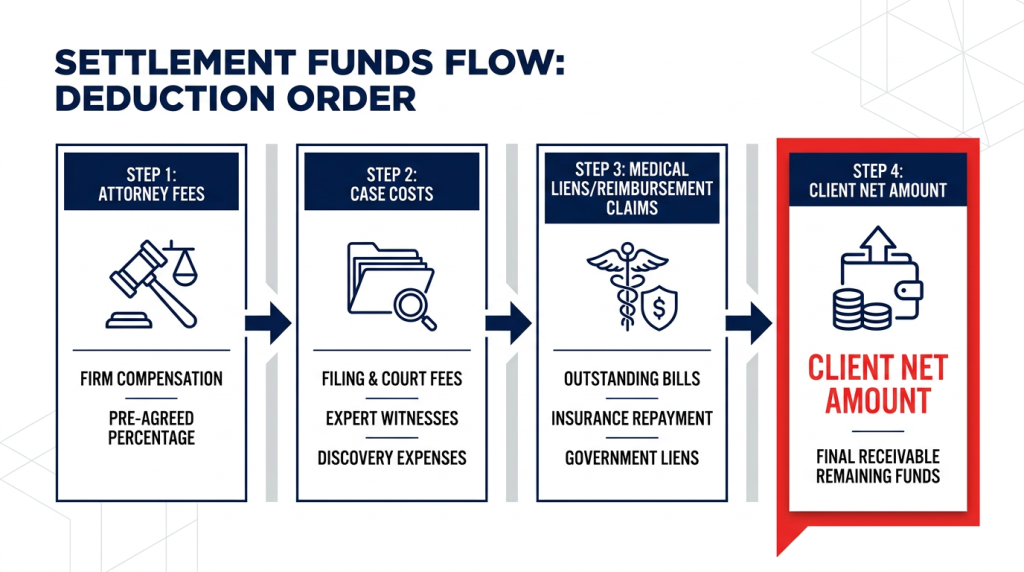
The at-fault party’s insurer pays the gross settlement to your attorney’s trust account. From there, deductions come out in a set order: attorney fees first, then case costs, then any medical liens or reimbursement claims. What remains after those deductions is your net recovery or the amount you actually receive.
What gets deducted before I receive my final check?
Beyond attorney fees and case costs, medical liens can significantly reduce your payout. If Medicare paid any of your treatment costs, it has a legal right to recover those payments from your settlement, following a formal recovery process. Health insurers often hold similar reimbursement rights. A good attorney will work to reduce or negotiate these obligations before distribution.
Why is the gross settlement different from what I actually keep?
The gross figure is what the insurer agrees to pay, not what lands in your account. Attorney fees, case costs, and lien repayments all come out first. Per a Michigan Bar ethics opinion that illustrates this math clearly, lien resolution is typically included within the contingent fee; meaning no separate charge for that work. Still, the deductions can be substantial.
Can an attorney’s work actually leave me with more money after fees than I’d net alone?
Yes, and this is the point that matters most. Attorneys routinely negotiate larger gross settlements and reduce medical liens, often recovering enough to more than offset their fee. The ABA notes that tax treatment of settlements adds another layer of complexity. A higher gross number, skillfully negotiated, often produces a better net outcome than a smaller DIY recovery with no fees taken out.
What should I ask for before agreeing to settle?
Request a written settlement statement before signing anything. It should show the gross amount, the attorney fee percentage and dollar figure, itemized case costs, and every lien or reimbursement claim being resolved. If any number is unclear, ask for an explanation. No reputable attorney will pressure you to sign without giving you a full breakdown first.
Choose the Level of Help That Protects Your Recovery
Here’s the reframe worth holding onto: a contingency fee isn’t a tax on your recovery; it’s the mechanism that makes a better recovery possible. Your attorney earns more when you do. That alignment, backed by the professional negotiation and lien reduction the sections above describe, is why most valid claims net more through representation than without it. Before you sign anything, confirm the exact percentage, clarify whether fees are calculated before or after case costs, and understand how every lien and reimbursement will be handled.
For most people with a valid injury claim, full-service contingency representation is the safer financial choice. ZAF Legal’s free AI assistant helps you understand whether you have a case, what it might be worth, and whether professional representation is likely to produce a better net recovery than going it alone. If you want more support, a DIY bundle is available starting around $49.99, and that payment is fully refunded if you later move to full service. When you’re ready to let an attorney carry the work and the risk, ZAF’s full-service contingency representation costs nothing upfront.
This content is for informational purposes only and does not constitute legal advice, and reading the content does not create an attorney-client relationship.